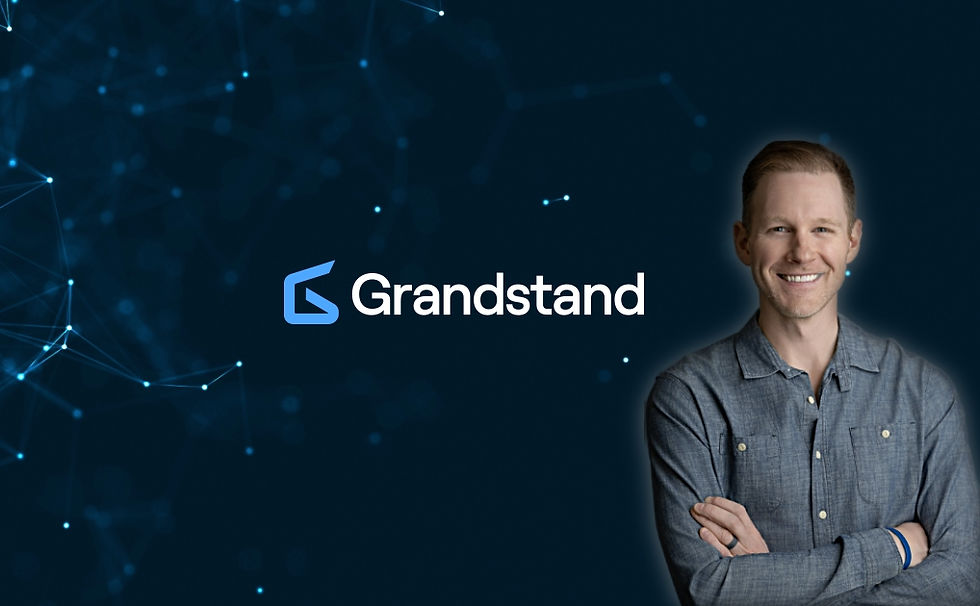
Agentic AI VIP supplier appoints former TSG CEO as chair

As VIP automation moves from optimisation to accountability, suppliers are being pulled directly into operator governance.

HeySeven.ai has appointed Rafi Ashkenazi as Executive Chair. On the surface, this looks like a familiar play: an early-stage supplier borrowing credibility from a well-known operator executive.
The more material detail is what sits alongside that appointment. Ashkenazi is currently Executive Chair of Hard Rock Digital. This is not a retired CEO lending brand value. It is an active operator chair aligning with a supplier operating inside the most sensitive part of the gambling stack: VIP account management.
That collapses the usual distance between supplier tooling and operator accountability. In VIP, that distance matters.
Why this matters more than it looks
VIP account management has quietly shifted category.
What was once a commercial optimisation function is now one of the most exposed regulatory surfaces in regulated gambling. Enforcement history has made this clear: affordability failures, inducement scrutiny, source-of-funds reviews and individual accountability regimes consistently converge on VIP handling.
Against that backdrop, “agentic AI” is not a neutral label. If taken literally, it implies systems that do more than recommend actions. They initiate them.
That is a structural change. Decision-support tools help humans act. Agentic systems risk becoming part of the decision itself. In VIP contexts, that distinction determines who is accountable when something goes wrong.
Ashkenazi’s relevance here is not product expertise. It is institutional memory. As former CEO of The Stars Group, he has operated businesses under intense regulatory scrutiny, across multiple jurisdictions, with public-market accountability. His appointment signals that HeySeven’s intended buyer is not a CRM lead. It is senior management that needs comfort that automation will not become tomorrow’s enforcement exhibit.
This is a governance signal, not a growth one.
The implicit assumption being made
The underlying assumption is that operators will accept agentic systems in VIP workflows if those systems are framed as risk-governed infrastructure rather than revenue accelerants.
That requires several things to hold simultaneously:
Regulators tolerate AI-mediated VIP interactions where control, logging and escalation are explicit
Boards prioritise defensibility over marginal VIP uplift
Suppliers sell into risk and compliance functions, not just commercial teams
Ashkenazi’s appointment is an attempt to de-risk that assumption by importing operator-side credibility directly into the supplier’s governance layer.
Where this breaks down (sceptical test)
The weakest dependency is accountability.
VIP programmes already operate under heightened scrutiny. Introducing agentic systems raises unavoidable questions regulators will ask after the fact, not at launch:
Who is the decision-maker when an AI agent adjusts incentives, limits or engagement cadence?
How are false positives and false negatives governed in real time?
Can the operator evidence why an action occurred, not merely that it did?
In jurisdictions with individual accountability expectations, those questions do not map cleanly onto autonomous or semi-autonomous systems. A governance-heavy chair appointment does not resolve that tension. At best, it signals awareness. At worst, it invites deeper scrutiny if regulators perceive automation being insulated by senior credibility rather than constrained by design.
Strategic reading: what this actually tells us about the market
This appointment fits a broader pattern emerging across the sector.
Sensitive supplier categories — VIP tooling, AML automation, behavioural risk systems — are being pulled closer to operator governance structures. “Former Tier-1 operator CEO” is becoming a sales unlock not because of star power, but because supplier risk is no longer abstract.
In practical terms, this suggests a narrowing loop between tool design and operator accountability. Historically, suppliers could sit one step removed from enforcement outcomes. That distance is shrinking. Boards increasingly want to know not just what a system does, but how it would be defended.
HeySeven’s move reflects that shift.
What would confirm or disprove this signal
Four indicators will determine whether this is structural repositioning or cosmetic governance:
Product posture Emphasis on auditability, human override and escalation would support the thesis. Language centred on autonomy and optimisation would undermine it.
Buyer profile Adoption led by compliance, risk or executive leadership would confirm intent. Sales driven purely through commercial teams would not.
Jurisdictional focus A US-first or tightly regulated market strategy would reinforce the governance framing. Expansion through lightly regulated markets would weaken it.
Regulatory engagement Explicit reference to regulatory expectations, or proactive dialogue, would indicate seriousness. Silence would be telling.
This is not a celebrity endorsement or a routine advisory appointment.
It is an attempt to reposition AI-driven VIP control as governance infrastructure rather than growth tooling. Ashkenazi’s presence is meant to reassure boards that automation can coexist with accountability.
Whether regulators agree remains the unresolved variable.